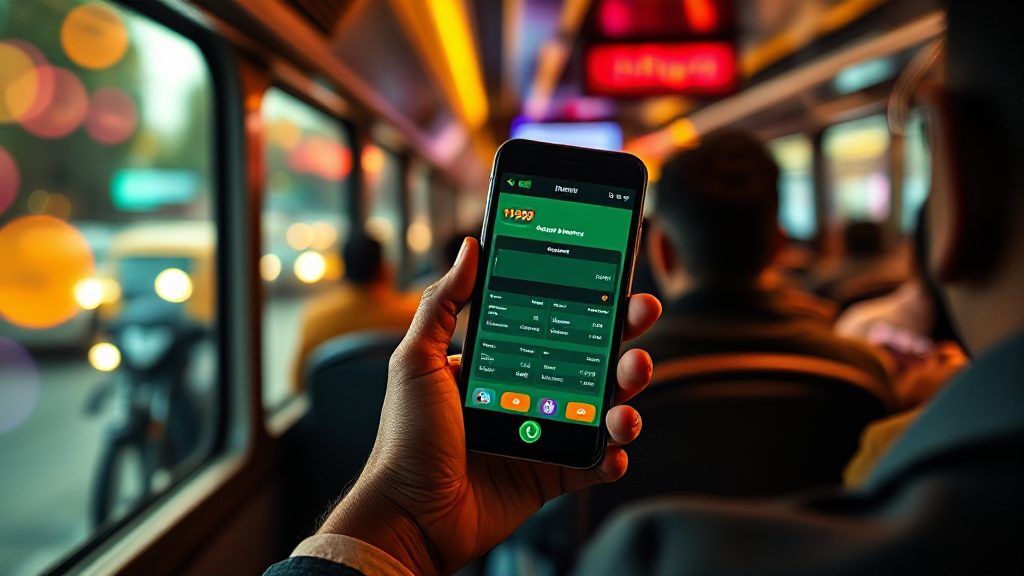
Betting in the Gaps: tk999 on the Commute
The bus has not moved for eleven minutes. Somewhere near Farmgate the traffic folds back on itself, and the man beside me is scrolling a green-and-black interface with the calm of someone checking a familiar route map. He is not in a hurry. He is using the gap. That is the question worth asking about tk999: what kind of activity does betting become when it is squeezed into the dead time between one stop and the next?
On a desktop at home, betting is a deliberate session. On a phone wedged between a rickshaw seat and a lunch box, it is something else — shorter, more reactive, shaped by the rhythm of the road. Understanding that shift matters more than any single feature of the platform.
Waiting is not empty time
A Dhaka commute is mostly waiting with brief interruptions of movement. The bus lurches, stops, lurches again. The passenger has perhaps ninety seconds of attention to spare before the next jolt. In that window, the quality of a decision drops faster than the speed of the tap.
This is where the commute context changes behaviour. At a desk, a user might compare odds across three markets or read a team’s recent form. On a bus, the thumb moves before the mind catches up. The gap is not a neutral container; it quietly rewards impulse.
Why queues and buses feel similar
A queue at a mobile-money counter and a bus seat in traffic share the same structure: low stimulation, unpredictable end point, and a phone already in hand. Both invite a quick look at an account balance, a pending selection, or a live score. The difference is that a queue is stationary and a bus is not, and motion adds a small but real cost to every interaction.
- Stationary waiting encourages browsing.
- Motion encourages single, fast actions.
- Interruption — a stop, a conductor, a call — breaks any longer thought.
The practical takeaway is simple: the shorter the gap, the less it should be used for anything that needs judgement. A commuter who treats a bus ride as a mini session is really handing decisions to the environment.
Motion, interruption and the shape of a session
Anyone who has tried to read a long article on a moving rickshaw knows the feeling: the eye jumps, the place is lost, the paragraph is abandoned. Betting on tk999 during a commute runs into the same friction. Screens tilt, notifications arrive, and the passenger’s attention is split between the phone and the next stop.
Interruption is the more interesting factor. A session that begins at Motijheel may be paused at Paltan and resumed at Shahbagh. Each pause is a chance to reconsider — or to forget what the original plan was. Users who keep a small written note of their intent, even a one-line reminder on the phone, tend to make fewer reactive changes than those who rely on memory.
What the platform’s mobile design assumes
The tk999 app is built for exactly this kind of fragmented use: registration, login and account access are designed around a phone screen rather than a desktop. That convenience is genuine. It is also the reason the commute setting deserves a second look, because a tool optimised for the gap will naturally be opened in the gap.
Two practical habits help here. First, decide before boarding whether the phone will be used for betting at all on that trip. Second, if it will, keep the action to a single check rather than a chain of them. A commute is a poor place to discover a new market.
Payments and the patience problem
Deposits and withdrawals add another layer. A commuter who tops up while standing in a queue may later find the confirmation message buried under other notifications. The safer pattern is to handle money movements when stationary and connected to a stable network, then use the journey only for viewing. This is not a restriction imposed by tk999 so much as a fact of mobile life in a city where signal strength changes block by block.
| Context | Best suited to | Risk |
|---|---|---|
| Bus in traffic | Quick balance or score check | Impulse taps |
| Rickshaw ride | Nothing that needs reading | Motion errors |
| Stationary queue | Reviewing a plan | Boredom scrolling |
A short reflection on the gaps
The most useful thing about noticing the commute is that it makes the invisible visible. Most betting decisions are not made in calm moments; they are made in the leftover minutes of a working day, on a bus, in a queue, between two errands. Once a user sees that pattern, the phone stops being a neutral tool and becomes a context to manage.
tk999, like any mobile platform, fits neatly into those gaps. Whether that is good or bad depends less on the app than on the person holding it. The commuter who decides in advance what the gap is for — a score, a balance, or nothing at all — keeps the upper hand. The one who lets the traffic decide has already handed it over.
